


Two more video essays by Danny Boyd of Cinemastix prompted this one: a structural reading of Steven Spielberg's three alien films and a study of the ensemble in Galaxy Quest (1999).
The pairing is less incongruous than it appears. Spielberg's films treat visitors from elsewhere with wonder or with terror; Galaxy Quest treats its own science-fiction premise as an affectionate joke. Yet both are, at bottom, lessons in how characters are organized and how seriously they are played, and both arrive at the conclusion that an outlandish premise succeeds only when the people inside it are arranged with structural clarity and performed without condescension. That conclusion has become increasingly central to my own work, including a recent ad whose premise is, by any reasonable standard, absurd.
Three factions, three permutations
Boyd's central observation is that Spielberg's three major alien films, Close Encounters of the Third Kind (1977), E.T. the Extra-Terrestrial (1982) and War of the Worlds (2005), are built from the same three character groups, which he calls the fractured family, the reactive establishment and the alien other. What changes from film to film is not the inventory of characters but their alliances: in each, two factions align and the third becomes the obstacle.
In Close Encounters, Roy Neary's encounter with a UFO sets him on a path toward first contact, and he finds allies among the scientists, led by François Truffaut's Claude Lacombe, who are working to decode the visitors' signals. The aliens are benign and the establishment is curious; the obstacle is Roy's own family, which cannot understand the compulsion that is consuming him and dissolves under its pressure. In E.T., the alignment rotates. Elliott's family, already fractured by his father's departure, takes in a stranded alien, and the establishment, the government agents and scientists pursuing the creature, becomes the threat. In War of the Worlds, the rotation completes itself. The alien other is now hostile and overwhelming, and Ray Ferrier, a father who barely knows his own children, is forced into an uneasy and often ugly alliance with the panicking human establishment simply in order to survive.
From communication to empathy to understanding
Boyd argues persuasively that each permutation serves a distinct theme. Close Encounters is fundamentally about communication and its failure: Roy cannot articulate what has happened to him to his wife, while the film's climax, in which scientists and visitors converse through a five-note musical phrase, imagines communication across the widest conceivable gulf. E.T. is about empathy: a boy who has lost a parent recognizes a creature who has lost its family, and the bond between them literally manifests as shared pain and shared healing. War of the Worlds is about understanding, or rather its absence. Ray cannot understand his children, and the invaders cannot be understood at all; the film resolves not through contact or compassion but because the aliens, as in H. G. Wells's novel, are undone by Earth's microbes.
The progression also tracks a change in Spielberg's outlook across nearly three decades, from the optimism of the late 1970s and early 1980s toward the anxieties of the years following September 2001. What interests me most as a writer, however, is the method rather than the history. By holding the factions constant and rotating their alliances, Spielberg makes each film's theme a function of its structure. The question of who is aligned with whom is not merely a plot convenience; it is the mechanism by which the film decides what it is about.
Galaxy Quest and the discipline of sincerity
Galaxy Quest, directed by Dean Parisot, began as a parody of Star Trek and its fandom, and it has endured to the point that, in 2013, Star Trek fans voted it the seventh-best Star Trek film ever made, an extraordinary distinction for a film that is not, technically, a Star Trek film at all. Boyd attributes its longevity to the ensemble, and in particular to a casting philosophy that Parisot has described as playing the material straight: favoring actors who would bring dramatic integrity to the roles rather than comedians who would play for the joke.
Alan Rickman is the clearest example. As a classically trained actor reduced to repeating a hated catchphrase under a prosthetic forehead, he plays the character's contempt for the material so convincingly that the performance becomes part of the joke, and yet he commits to the role within the role with the seriousness he might bring to Shakespeare. That commitment is precisely what allows the film's most sincere scene, in which his character finally honors the catchphrase for a dying admirer, to land with genuine emotional force. Sam Rockwell, as a former extra who played a crewman killed in a single episode, builds an entire arc out of escalating terror, and the comedy works because his fear is real: the stakes, as Rockwell has observed, have to be high for the humor to function at all. Tony Shalhoub's imperturbable engineer supplies the opposite energy, a nonchalance so complete that it becomes its own kind of comedy, and the scenes in which he and Rockwell share the frame derive much of their humor from that juxtaposition. The film is an ensemble in the full sense, a set of deliberately contrasting temperaments, each played with total conviction.
The same lessons, applied
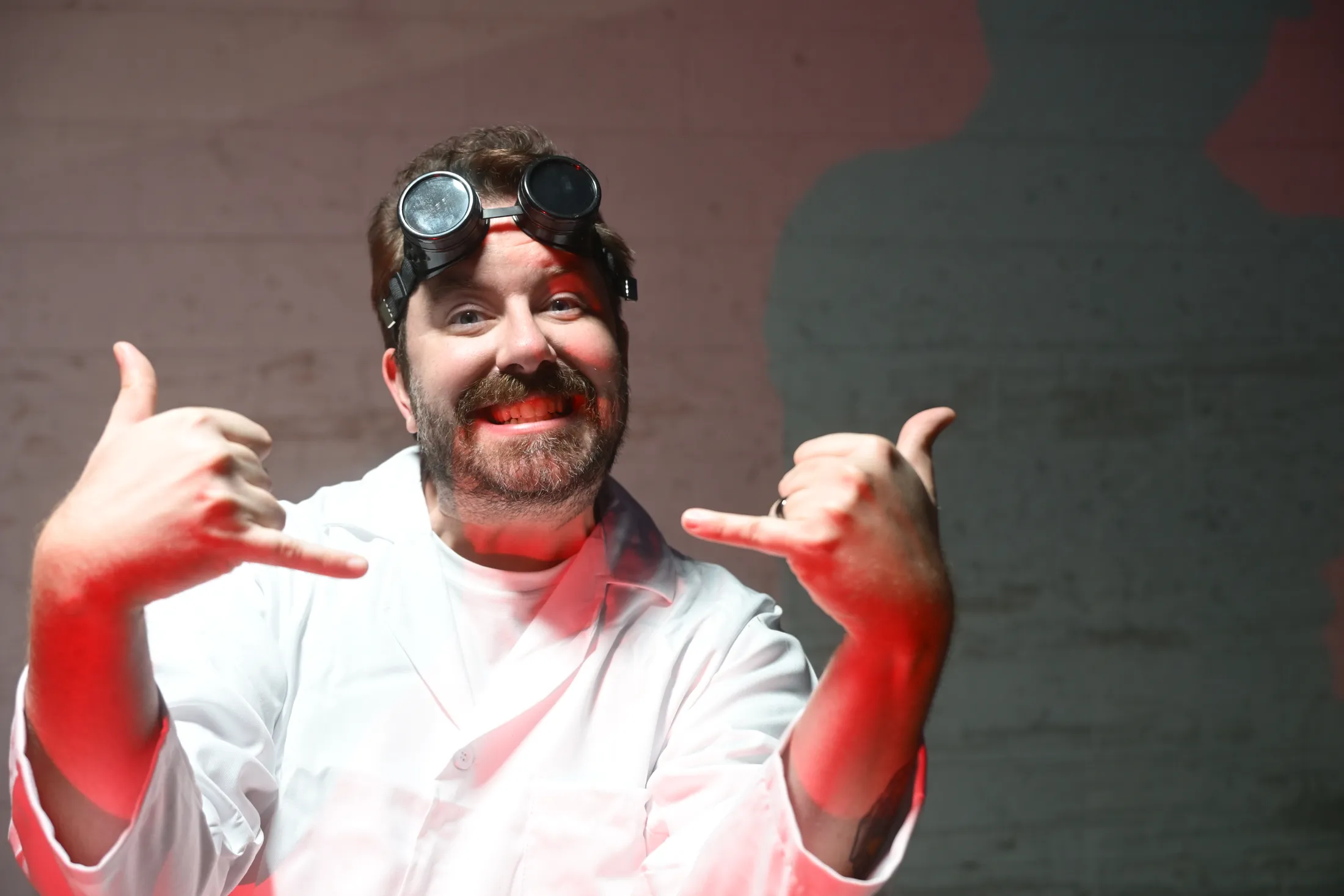
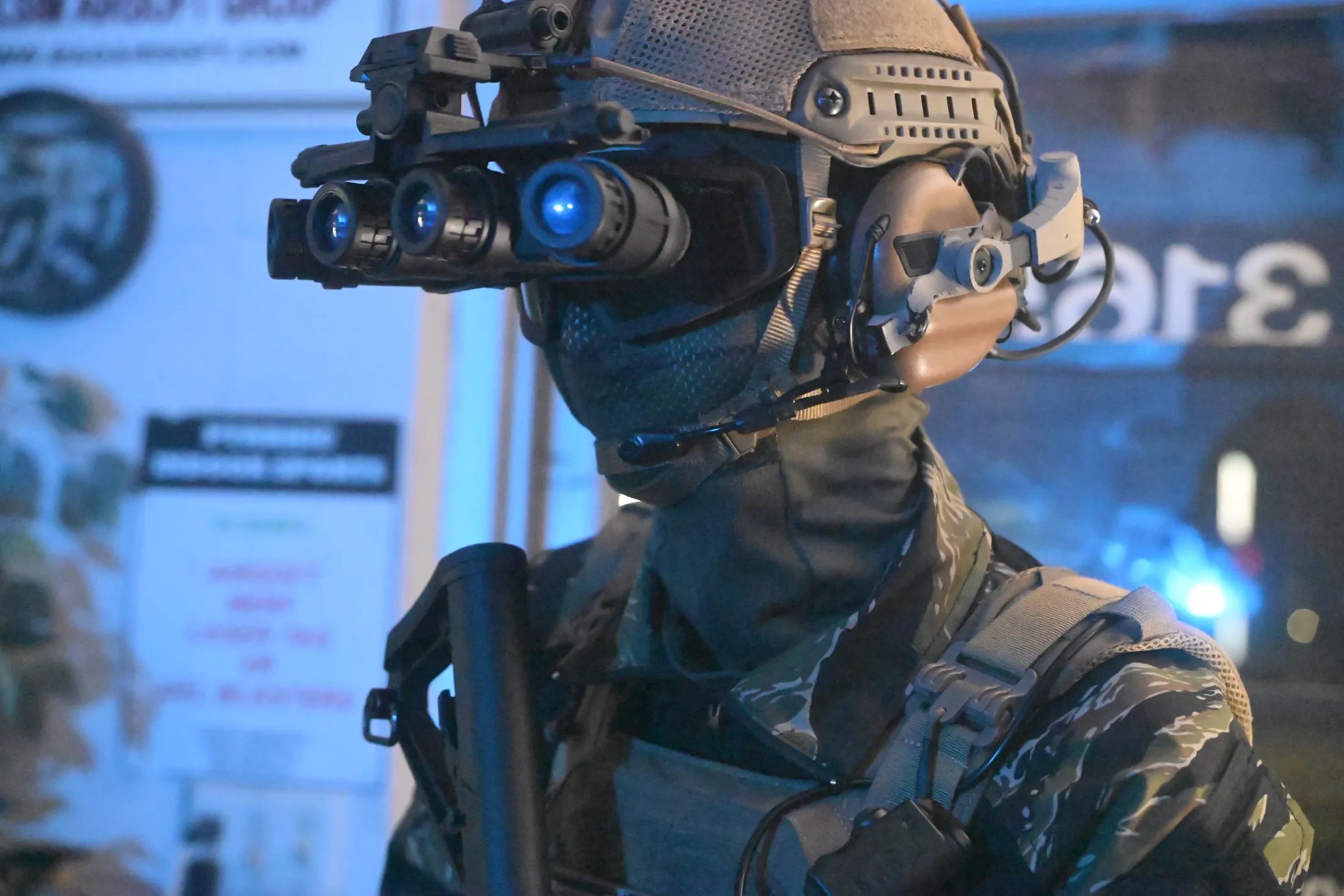
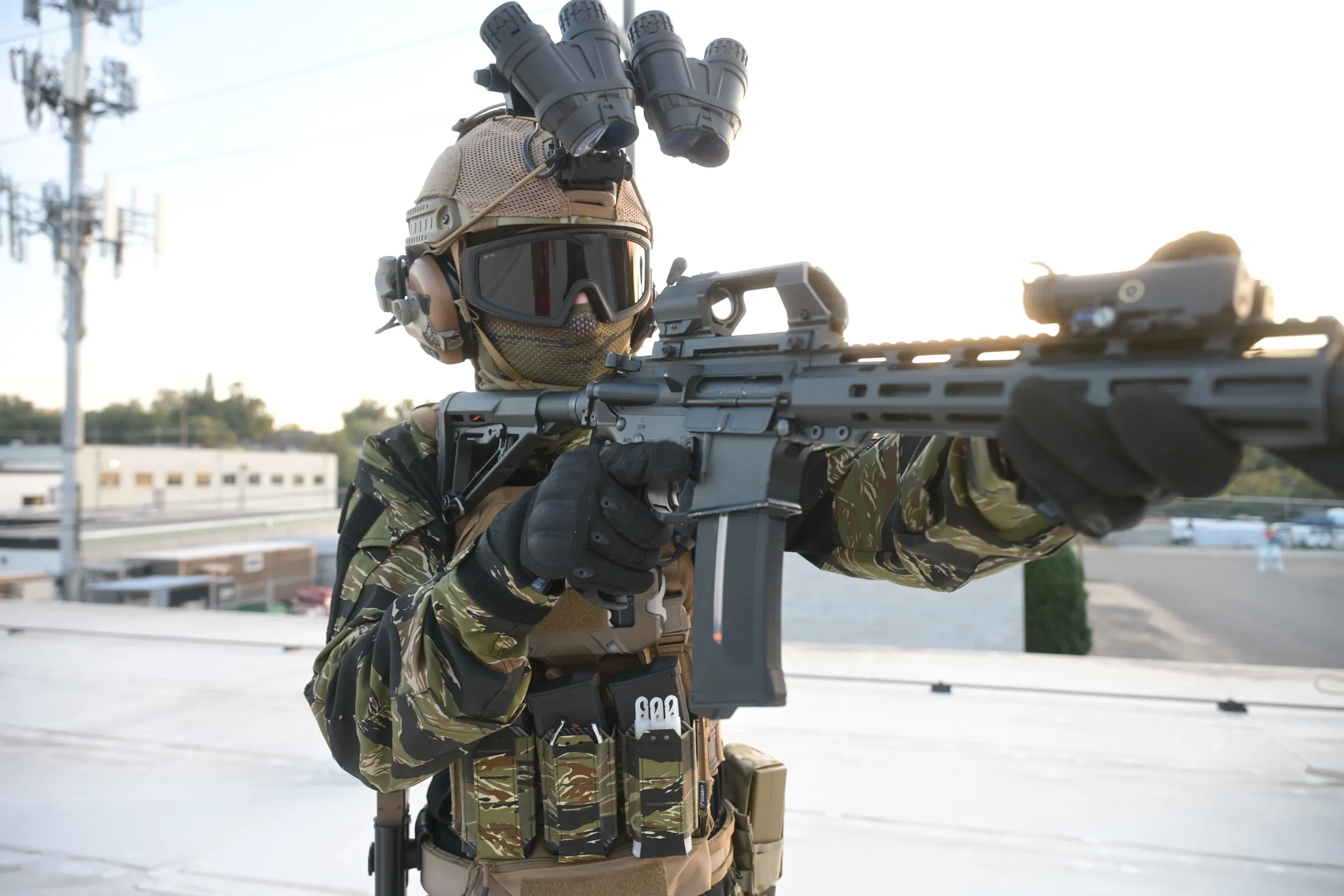
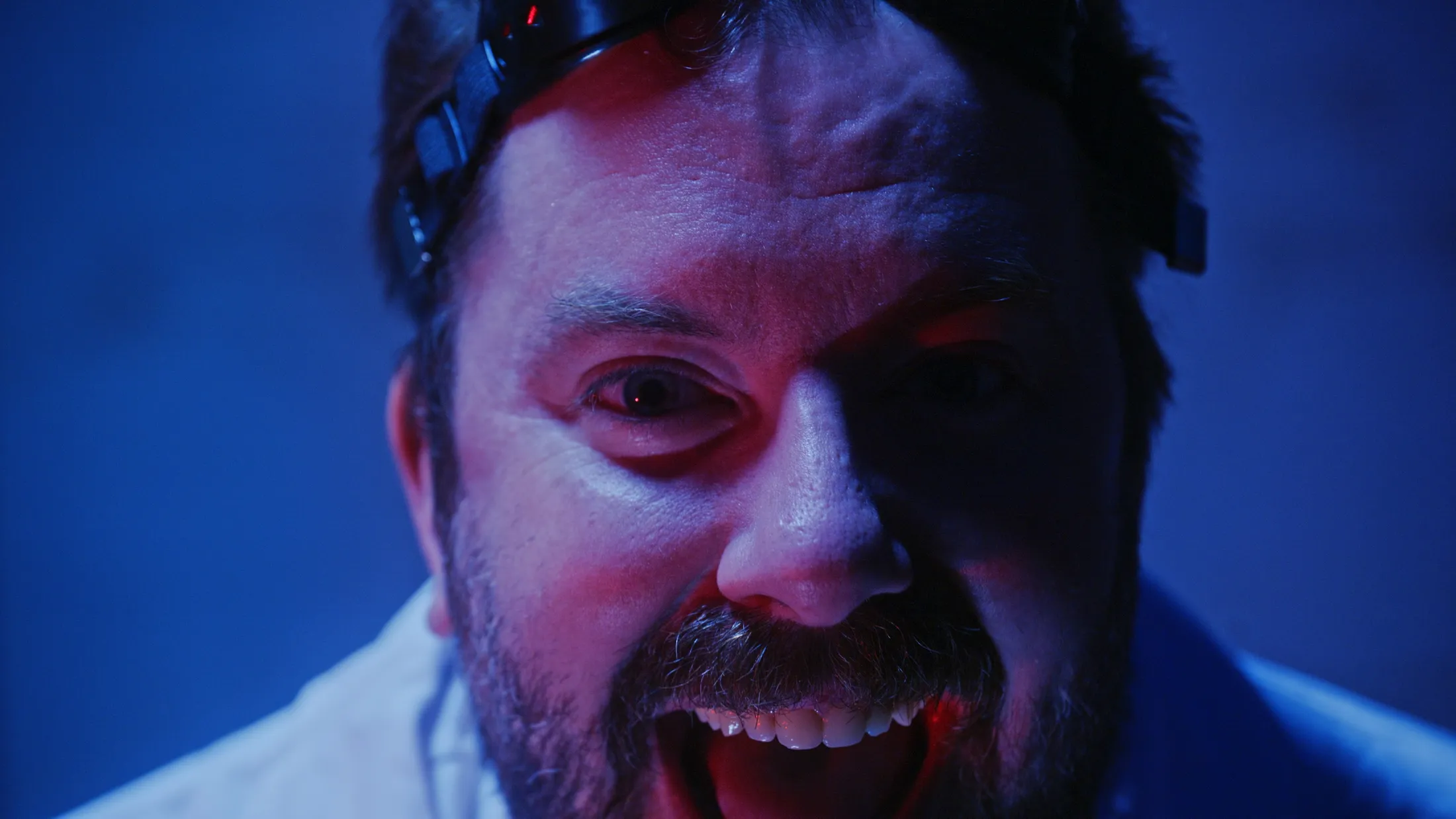
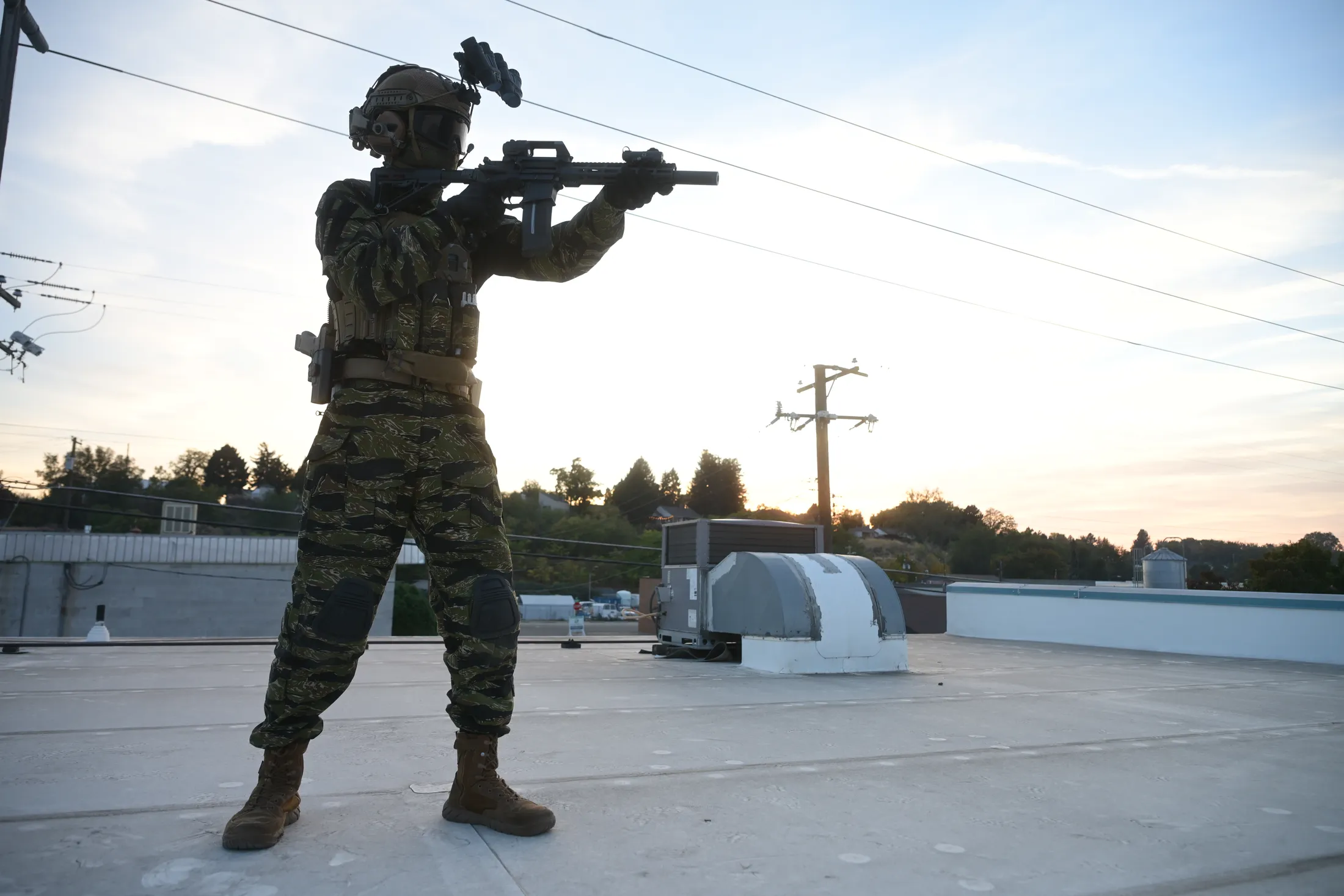
The photographs above come from a spec-ops ad I wrote and shot for Combat Sport Supply, an airsoft and tactical gear shop, and its premise could easily have been played as a wink: a lone commando air-assaults onto the shop, clears it room by room, and confronts a mad scientist who announces that he has already written the code for an AI that will take over the world. The decision that made it work, I think, was the one Parisot made with Galaxy Quest. The commando is played and shot as though the mission were entirely real, with golden-hour rooftop coverage, night-vision silhouettes and the visual grammar of a serious action film, while the villain is allowed to be gleefully theatrical. The humor comes from the collision between the two registers, and it only functions because neither performer winks at the camera.
The ad also has a structure that Spielberg's framework makes legible. The shop is home ground, the commando is its defender, and the scientist with his runaway machine occupies the place of the alien other, an intelligence that cannot be reasoned with. A feature I am developing uses a version of the same triangle, with an artificial intelligence in the role that Spielberg's films assign to visitors from elsewhere, and Boyd's analysis has clarified for me that the most important decision in that story is not what the intelligence is but which of the human factions ends up allied with whom.
I should acknowledge a limit. A one-minute ad cannot develop alliances or rotate them; it can only establish them. The structural ambitions of a Spielberg film require running time that short-form work does not have, which is one reason I find the feature-length version of the idea so compelling, and also one reason I am cautious about claiming the ad does more than it does.
My film work, including my feature Opportunity, is on the film page, and two related essays are Color as Character and The Art of Holding Back. For a film, ad or music video in Boise and the Treasure Valley, get in touch.
Questions people ask
What are Steven Spielberg's alien movies?
Close Encounters of the Third Kind (1977), E.T. the Extra-Terrestrial (1982) and War of the Worlds (2005). Each uses a family, an establishment and an alien presence, but rearranges which two are allies.
How do the aliens die in War of the Worlds?
As in H. G. Wells's novel, the invaders are killed by Earth's microbes, not by human weapons.
Who directed Galaxy Quest?
Dean Parisot directed Galaxy Quest (1999), starring Tim Allen, Sigourney Weaver, Alan Rickman, Tony Shalhoub and Sam Rockwell. In 2013 Star Trek fans voted it the seventh-best Star Trek film.
What does playing a comedy straight mean?
Performing ridiculous material with complete sincerity, as if the stakes were real, so the humor comes from the situation rather than from actors signaling that they are joking.