Most portrait photographers in Boise organize their practice around golden hour; I tend to wait until it has passed, because after dark the light ceases to be something I receive and becomes something I construct, and the resulting portrait begins to read less like a snapshot than like a frame extracted from a film.
Defining the cinematic portrait
A cinematic portrait may be defined as a portrait illuminated and composed according to the conventions of narrative cinema. Rather than relying on the even, flattering light of conventional portraiture, it depends upon a single dominant source, substantial areas of shadow and a deliberately chosen color, so that the image carries a discernible mood and implies a narrative extending beyond its borders. A successful example invites the viewer to speculate about what occurred immediately before the exposure and what will follow immediately after it.
None of this is novel, since painters established the governing vocabulary centuries ago. Chiaroscuro, from the Italian for "light-dark," denotes the pronounced contrast between illuminated form and surrounding shadow, and Caravaggio carried the principle so far that his figures appear to emerge from absolute darkness. Rembrandt lent his name to a lighting pattern still employed by photographers, in which a key light placed high and to one side leaves a small triangle of illumination on the shadowed cheek. Cinema inherited these conventions wholesale, and photographers such as Gregory Crewdson subsequently returned them to the still image, staging suburban tableaux with the lighting apparatus and crews of a feature film.
In practice, the approach rests on three interdependent decisions. The first concerns the key light, the primary source illuminating the face, which I generally position to one side so that half the face recedes into shadow, lending the features structure and the image tension. The second concerns shadow itself, which I treat as a compositional element rather than a deficiency, allowing portions of the frame to fall into complete darkness on the principle that what an image withholds shapes how we interpret what it reveals. The third concerns color as a carrier of meaning: red tends to connote heat, danger or desire, blue connotes distance or composure, and warm amber connotes memory, and I settle the palette before the session in much the same way a cinematographer would before a scene.
Michael Mann has been a significant influence in this regard; in films such as Collateral, nocturnal Los Angeles functions almost as a protagonist, with every sodium-vapor streetlight performing narrative work. David Lynch is another, given his capacity to render an ordinary domestic interior unsettling through illumination alone, and Edward Hopper's Nighthawks belongs in the same lineage, since a lit diner, a deserted street and four figures who are not quite together articulate an entire narrative through the distribution of light.
Practical light and the plausibility of the image
Many of these portraits are constructed around practical light. In the vocabulary of film production, a practical is a light source that appears within the scene itself, such as a lamp, a neon sign, a sparkler, a vehicle's headlights or a window, as opposed to a studio instrument concealed outside the frame. When the viewer can locate the source of illumination, the image acquires a measure of plausibility, and that plausibility in turn licenses a far more assertive use of color than would otherwise be credible.
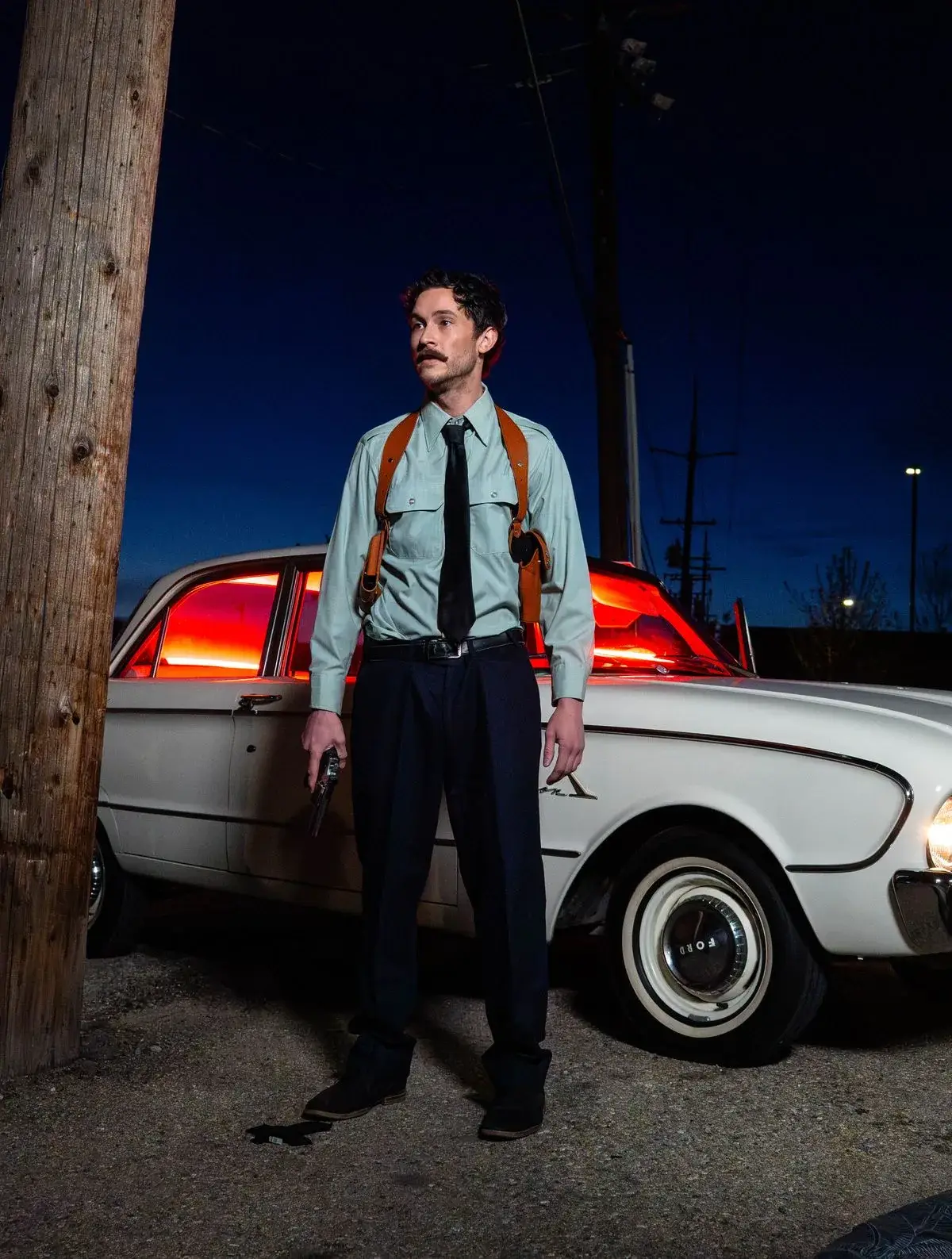
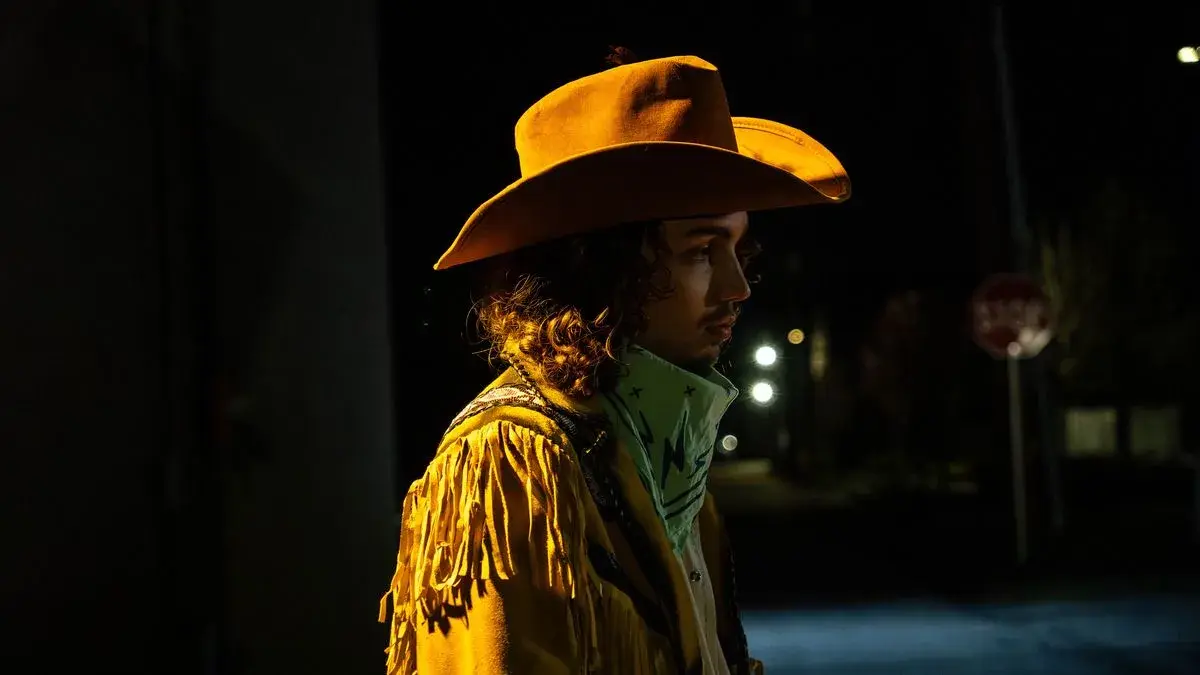
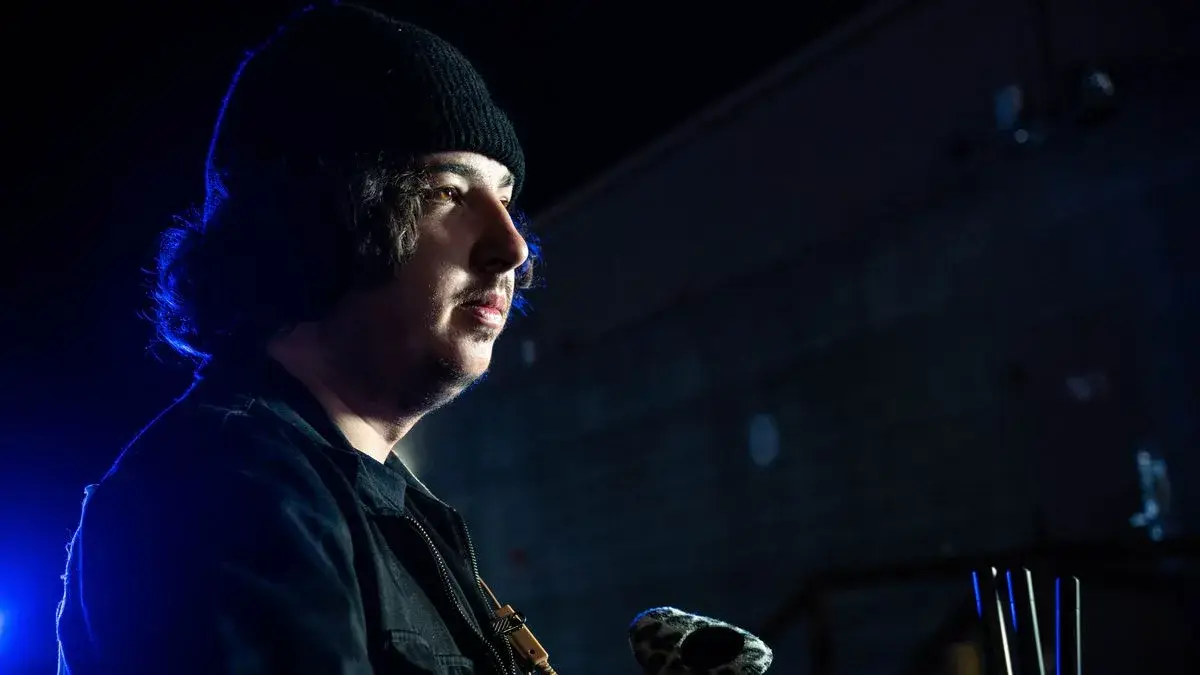
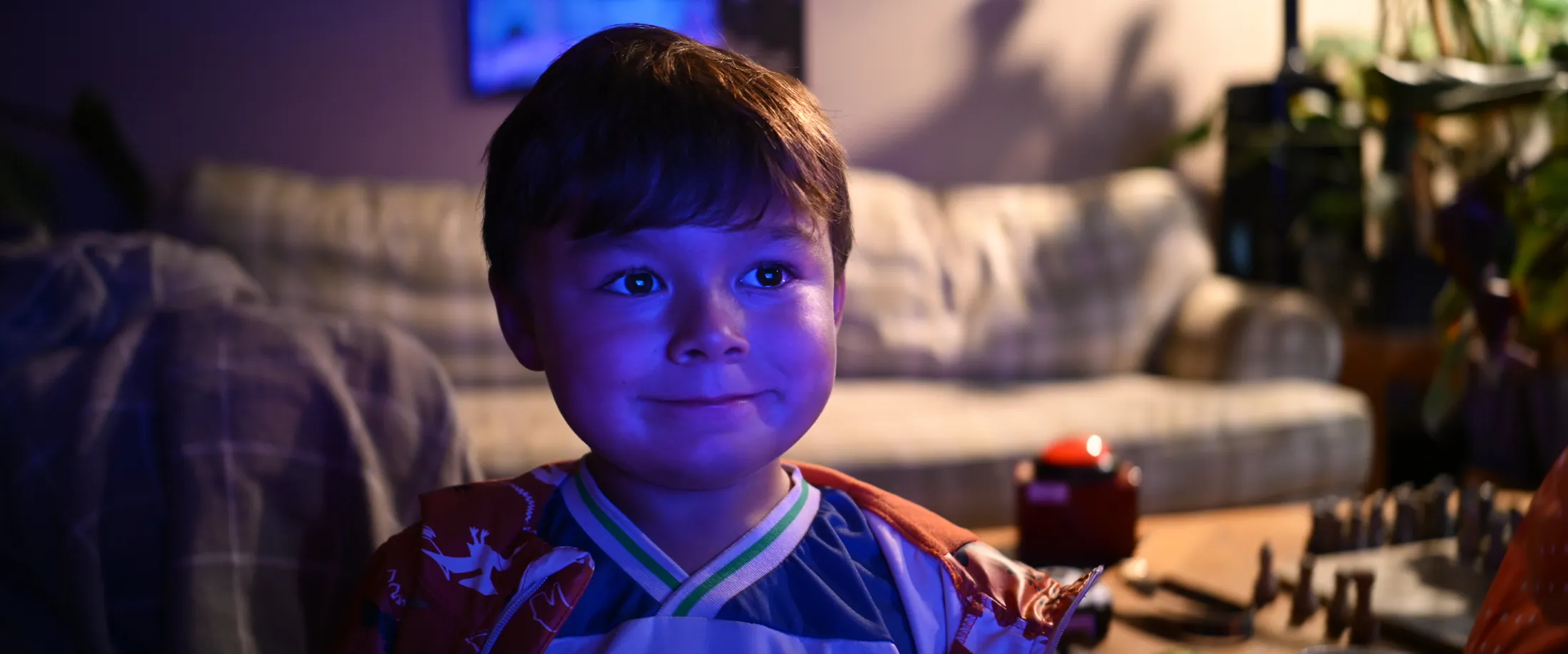
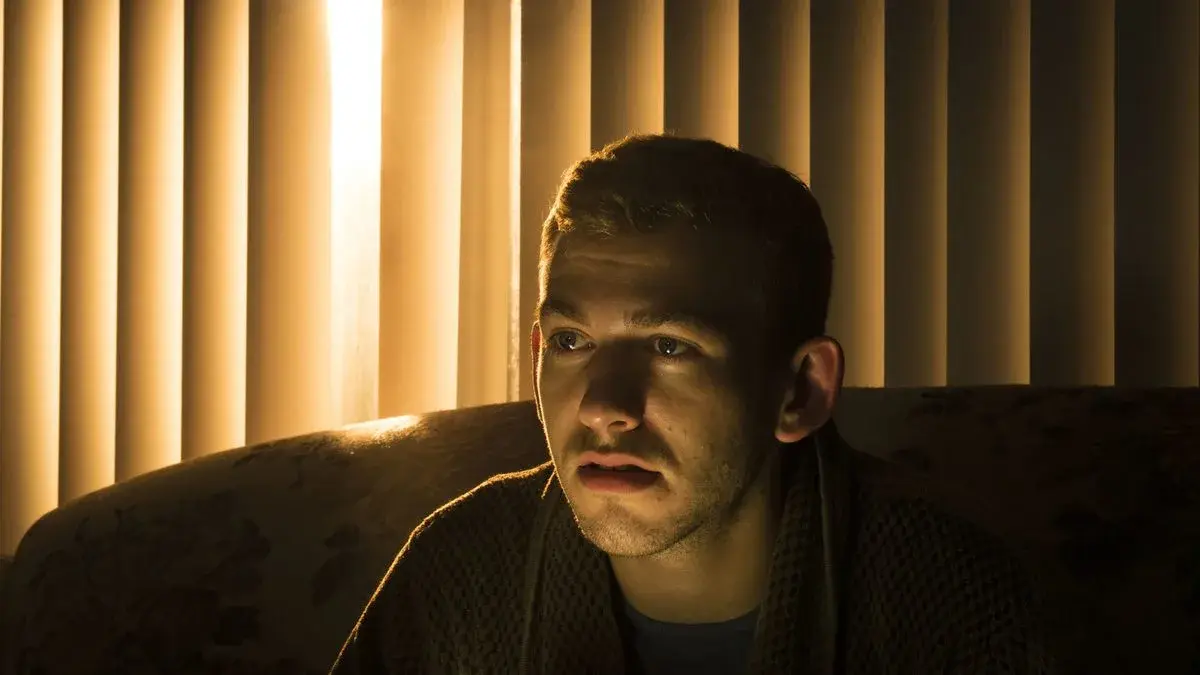
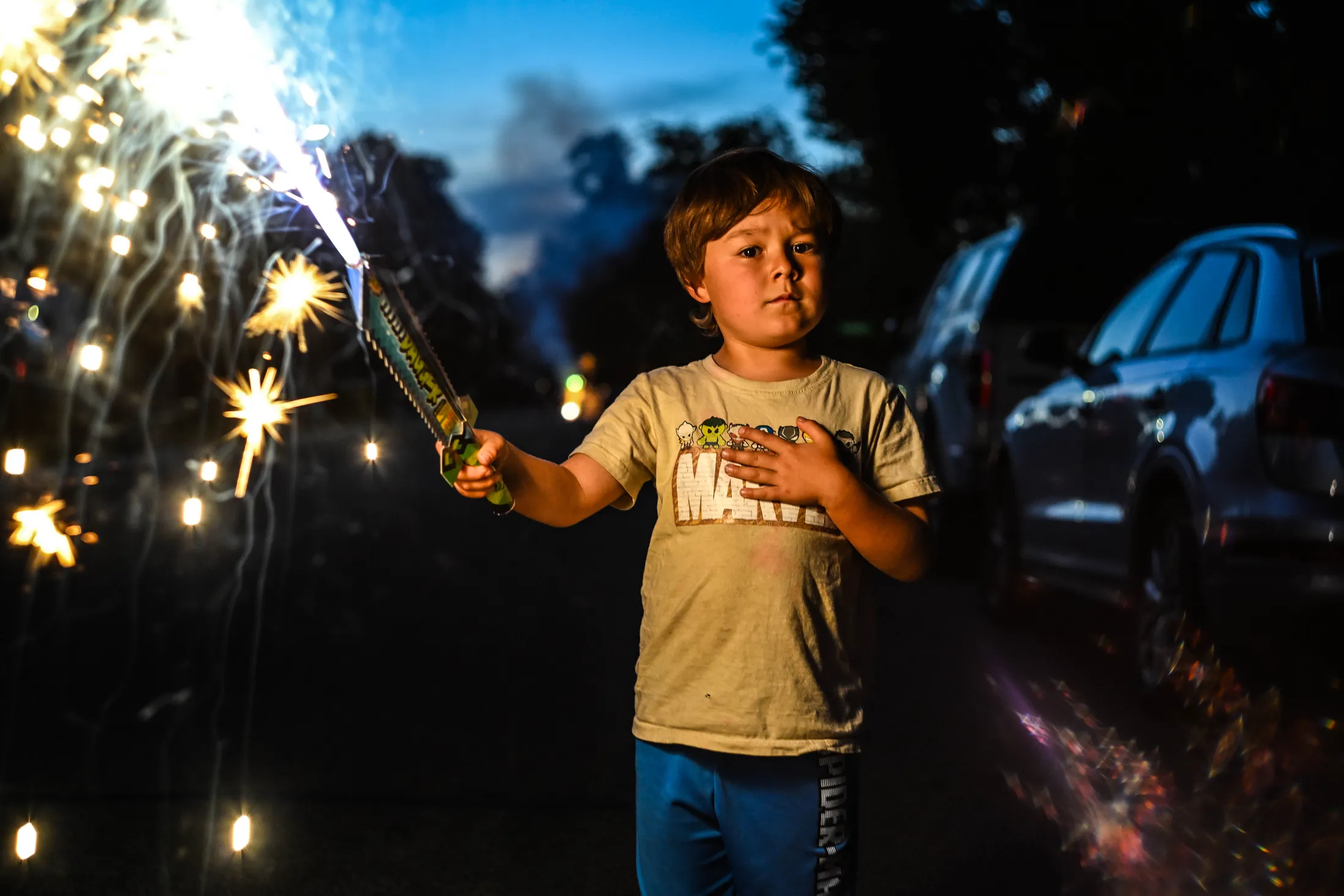
Several of the photographs above illustrate the principle. Two of them, "Red Light" and "Smokeshow," were made on the set of Smokeshow Joe, a short film by my friend, the Boise director Mason Dodson, which has not yet been released. The lighting in those frames was designed for the film rather than by me, and that makes them instructive in a particular way, because they demonstrate how a scheme conceived for a narrative scene can sustain a still portrait on its own. In "Red Light," a man in red suspenders stands beside a classic automobile whose taillights glow red against a cool blue dusk, so that the car becomes the apparent motivation for the color; "Smokeshow," a woman in a cowboy hat and fringe jacket under hard nocturnal light, reads as a still from a Western precisely because it borrows that genre's lighting grammar. "Akihiro Blue Light" demonstrates how a single color can transform an unremarkable living room into a set without a single object being moved, while "Fireworks" relies on a sparkler as its sole source, a light so small, warm and mobile that no two exposures resemble one another. "Jayson Golden," finally, employs window light, the oldest practical of all, which falls away softly into shadow in the manner of a seventeenth-century Dutch interior.
Having made more than forty short films and a feature, Opportunity, and having arrived at filmmaking by way of painting, I draw no firm distinction between a portrait and a scene, because both pose the same fundamental questions: where the light originates, what the color signifies, and what the subject is experiencing at that particular moment.
Appropriate applications, and their limits
This approach serves certain clients particularly well. Musicians frequently need press images, album artwork or poster imagery whose visual character corresponds to the character of their music; actors often want images with greater range and atmosphere than a standard headshot affords; artists, creative professionals and small brands require portraits that articulate a point of view; and some individuals simply want a portrait that does not resemble everyone else's. It serves other needs poorly, however, and candor on that point is preferable to overpromising: if the brief calls for a bright, evenly lit corporate headshot against a white background by the end of the week, I am not the appropriate photographer, and there are others who execute that work very well.
The structure of a night session
Each session begins with the design of the image. Before we photograph anything, we settle the location, the wardrobe and the palette, and if there is a car, a garment, an instrument or a place of personal significance, the image is constructed around it rather than merely accommodating it. We then begin after sunset, frequently during blue hour, the interval of civil twilight following sunset but preceding full darkness, when the sky retains a deep, saturated blue that balances naturally against warm artificial sources; sunset times for any date can be obtained from NOAA's solar calculator. As darkness deepens, the practical sources assume control of the image, and we proceed through a series of discrete setups, each organized around a single source, a single location and a single idea, and each refined until it is resolved before we move to the next.
Clients are well advised to bring textured clothing in solid colors, since leather, denim, wool and fringe all hold light attractively; any object that carries their story; and a warm layer, because Boise evenings cool rapidly even in midsummer. The complete series appears on the portraits page, and anyone interested in planning a night session in Boise, Meridian, Eagle or elsewhere in the Treasure Valley is welcome to get in touch.
Questions people ask
What is a cinematic portrait?
A portrait lit and composed like a frame from a film: one main light, deep shadows and a deliberate color, so the picture has a mood and suggests a story.
What is practical lighting in photography?
Light that comes from a source visible in the scene, such as a lamp, neon sign, car lights, a sparkler or a window, instead of a hidden studio light.
When is the best time for a night portrait?
Blue hour, the short window after sunset when the sky is still deep blue, and then full dark, when practical lights take over. NOAA's solar calculator gives sunset times for any date.
What should I wear?
Solid colors and clothes with texture, like leather, denim, wool or fringe, which catch light well. Bring anything that tells your story, and a warm layer.
Where in Boise do you shoot?
Anywhere in Boise, Meridian, Eagle, Nampa, Garden City and the Treasure Valley: streets, garages, living rooms, or a place that means something to you.